
Most real estate agents do not need another app.
They do not need another login, another dashboard, another training, or another tool that promises to save time but quietly adds more work to their day.
They need help getting the work done.
That is where AI for real estate agents is starting to change the game. Not because AI replaces the agent, but because AI can help with the work that eats up hours every week.
Think listing copy, neighborhood research, single property websites, blog ideas, social media content, property videos, and online visibility.
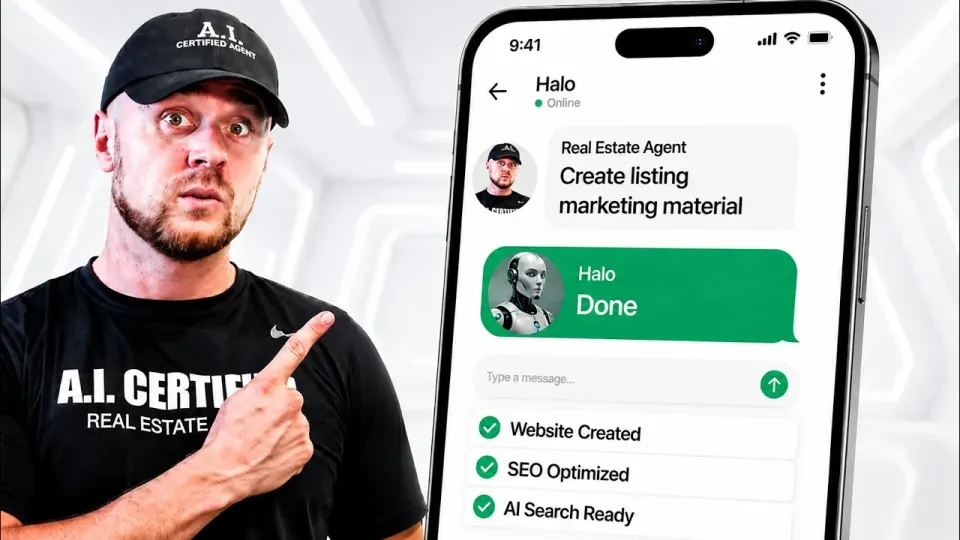
Halo is one example of this shift. It is designed to work like an AI-powered Chief Marketing Officer that real estate agents can reach through simple text messages. Instead of opening five different tools to market one listing, an agent can text what they need, and Halo helps coordinate the work behind the scenes.
Morgan Stanley Research found that AI can automate 37% of tasks in real estate, representing $34 billion in operating efficiencies.
That does not mean AI is replacing the relationship side of the business. It means the repetitive work that eats up the week is becoming easier to manage. The agent still brings the trust, local expertise, negotiation skill, and client relationships. AI helps handle more of the execution.
In this Free Halo Live Webinar, Nick Krem, CEO and co-founder of the Krem Institute of Artificial Intelligence, is joined by Eric Post, Founder and Chief Architect of Huzi AI, to discuss how AI agents like Halo are changing the way real estate professionals market properties, build authority online, get found by AI search, and streamline day-to-day business operations.
Real estate agents are not short on tools. They are short on time.
Most agents already have a CRM, an IDX website, email software, social media accounts, transaction tools, design apps, lead portals, and maybe a few AI tools they tested once and forgot about.
Each tool promises to make life easier.
However, many tools create another thing to learn, another login to remember, and another dashboard to check.
That is the real problem.
A busy agent may watch a training for one hour, then spend three more hours trying to figure out how to use the tool. By the time they understand it, another new AI update comes out.
As Nick Krem often says, “Simplicity scales. Complexity does not.”
For agents, that means the best AI tools for real estate are not always the ones with the most features. The best tools are the ones that help finish the work without making the agent feel buried in technology.
So what are AI Agents? An AI agent is like a digital assistant that can help you get work done.
A regular chatbot waits for you to ask a question, then it gives you an answer.
An AI agent can go a step further. It can understand what you want, help plan the steps, use tools, remember details, and move the task forward.
Google Cloud explains AI agents as software systems that use AI to pursue goals and complete tasks for users. In simple terms, they are built to do more than chat. They are built to help complete work.
Here is the easiest way to understand it as a real estate agent.
A chatbot can help you write a listing description.
An AI agent can help you market the listing.
That may include:
AI agents are not just giving you ideas. They are helping with execution.
For a solo agent, that can feel like getting extra support without hiring a full-time marketing team.
Halo is an AI-powered Chief Marketing Officer for real estate agents.
A Chief Marketing Officer, or CMO, is usually the person in charge of marketing strategy. In a big company, that person helps plan campaigns, manage content, improve visibility, and make sure the brand is seen by the right people.
Most solo agents do not have a CMO.
They are the CMO.
They are also the salesperson, admin, content creator, listing marketer, follow-up person, and client support team.
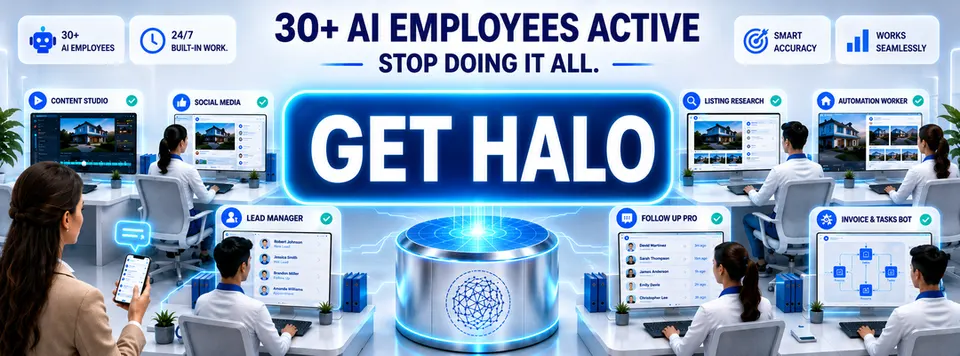
Halo is built to help with that marketing load. It's a system that coordinates more than 30 AI employees behind the scenes. The agent does not have to manage each AI employee. The agent simply sends the request, often by text, and Halo helps organize the work.
That is why Halo is different from simply opening ChatGPT and asking for a caption.
It is designed to help complete a larger marketing workflow.
-w960.webp)
Halo works through simple requests.
For example, an agent could text:
“I have a new listing. Can you help me?”
From there, Halo can help create marketing assets around that listing.
That may include a single property website, listing copy, neighborhood content, FAQs, lifestyle descriptions, and video-style assets from listing photos.
The agent can also ask for changes in normal language.
For example:
This is powerful because most agents already know how to text.
They do not need to write perfect prompts.
They do not need to learn a complicated workflow.
They do not need to sit at a desk for hours.
They can explain what they need in plain English and let the AI system help move the work forward.
ChatGPT is useful, but the work still depends on the person using it.
You need to know what to ask.
You need to copy the answer.
You need to paste it somewhere else.
You need to check it, edit it, organize it, and decide what to do next.
That can still save time, but it can also feel like another task.
Halo is different because it is built around execution. It is not just answering one prompt. It is helping coordinate the marketing work around the agent’s business.
Think of it this way.
ChatGPT is like asking one smart assistant for help with a task.
Halo is more like texting a marketing manager who can organize the team behind the scenes.
That is the heart of agentic AI in real estate. It turns AI from “help me write this” into “help me get this done.”
Sellers hear the same promises all the time.
“I’ll put your home on the MLS.”
“I’ll post it online.”
“I’ll share it on social media.”
“I’ll market it to buyers.”
Those promises are expected now. They do not always make an agent stand out.
Halo gives agents a better story to tell.
Instead of saying, “I will market your home,” an agent can show a full marketing system. They can show how the listing may get its own property website, neighborhood content, lifestyle copy, FAQs, video-style assets, and online content that helps create a stronger digital footprint.
That gives the seller something real to see.
It also helps the agent explain their value better.
When two agents on a listing appointment sound the same, sellers often compare based on price or commission. But when one agent shows a better marketing system, the conversation changes.
A basic real estate website is not enough anymore.
Many real estate websites look nice, but they do not say much. They may have a bio, a search page, a contact form, and a few generic buyer and seller pages.
That may help a little, but it does not always build authority.
An authority site is different.
An authority site helps people understand who you serve, what you know, and why they should trust you.
For example, an agent who works with relocation buyers could create content about:
An agent who serves military families could create content about:
An agent who loves working with car enthusiasts could create content about local car shows, homes with garage space, swap meets, and lifestyle topics that matter to that audience.
That kind of content is more useful than a generic “I help buyers and sellers” page.
It also helps people remember the agent.
Buyers and sellers are not only using Google the old way anymore.
They are asking AI tools questions like:
People are not just searching for websites. They are asking AI tools for answers.
That means agents need content that AI tools can understand.
Halo helps support this by creating content around SEO, AEO, and GEO.
Here is what that means in simple terms.
SEO helps people find you through search engines like Google.
AEO helps answer common questions clearly.
GEO helps AI tools understand your content and connect it to the right topics.
You do not need to memorize the terms.
The simple idea is this:
If your online content clearly explains your market, your niche, your listings, and your expertise, AI tools have more information to understand who you are and what you should be known for.
That can help agents become more visible in a world where buyers and sellers are asking AI before they ever click a website.
Text-based AI works because it fits the way agents already live.
Most agents are not sitting in front of a computer all day.
They are driving to appointments, walking homes, answering calls, meeting sellers, checking on deals, negotiating, and putting out small fires.
That makes it hard to build a full marketing system manually.
But texting is easy.
An agent can send a quick request between showings. They can ask for an update after a listing appointment. They can request a change without opening a design tool or logging into a website builder.
That is why Halo’s text-based approach is practical.
It lowers the barrier.
Agents do not need to become tech experts. They only need to know what they want done.
If you’re tired of doing all the marketing yourself, Halo helps you turn a simple text into listing websites, property content, neighborhood pages, videos, and AI-search-friendly marketing.
It’s built for agents who want to look different in listing appointments, get found online, and save time without adding another complicated tool.
Want to see how AI can help you win more listings?
Join the Free Halo Live Webinar, hosted by Nick Krem, CEO and Co-Founder of the Krem Institute of Artificial Intelligence, every Tuesday at 12 PM ET.
👉 Join the Free Halo Live Webinar
Q: How can real estate agents use AI to save time?
A: Real estate agents can use AI to save time by letting it help with repetitive tasks like listing descriptions, blogs, FAQs, neighborhood research, social media posts, and property marketing. Tools like Halo go a step further by helping agents request this work through text, so they do not have to manage every task manually.
Q: Can AI help real estate agents market listings?
A: Yes. AI can help real estate agents market listings by creating listing copy, single property websites, neighborhood highlights, buyer FAQs, social media content, email copy, and video-style assets. Halo is built for this kind of workflow because agents can text the listing details and have the AI-powered CMO help coordinate the marketing pieces.
Q: How can AI help real estate agents get found online?
A: AI can help real estate agents get found online by creating helpful local content that answers the questions buyers and sellers are already asking. This can include neighborhood guides, relocation pages, FAQs, market updates, and niche content. Halo supports this by helping agents build authority sites and content designed for SEO, AEO, and GEO.
Q: Can AI help real estate agents win more listings?
A: Yes. AI can help real estate agents win more listings by making their marketing plan look stronger and more complete. Instead of only promising MLS exposure and social media posts, agents can show sellers property websites, lifestyle content, neighborhood pages, FAQs, and video-style assets. Halo helps create these materials faster, which can make the agent stand out in a listing appointment.
Q: What is the best AI tool for real estate marketing?
A: The best AI tool for real estate marketing is one that helps agents get actual work done, not just create random content. For agents who want help with listing marketing, authority sites, neighborhood content, and AI search visibility, Halo is a strong example because it works like an AI-powered Chief Marketing Officer that agents can reach through text.
Q: Can AI replace real estate agents?
A: No. AI cannot replace the trust, local knowledge, negotiation skill, and personal guidance that real estate agents provide. AI is best used for support tasks like research, content creation, marketing assets, and follow-up. Halo helps with the execution side so agents can spend more time on client relationships and high-value conversations.
-w960.webp)











-w960.webp)