Real estate websites are entering a new era.
For years, most agents treated their website as a place to show listings, display a headshot, collect leads, and prove they were active in the market. That worked when buyers and sellers searched on Google, clicked through websites, and compared agents on their own.
Now, the search journey is changing.
Buyers and sellers are asking ChatGPT, Gemini, Perplexity, Grok, and Google AI for answers before they ever visit an agent’s website. They are asking who the best local agent is, what neighborhoods they should consider, whether now is a good time to sell, and what they should know before making a move.
Because of that, a real estate website can no longer be built only for people. It also needs to be built so AI tools can understand it, source it, and cite it.
In this Live AI Workshop, Nick Krem and Eric Post, Founder & Chief Architect of Huzi AI, demonstrated how Halo can help real estate agents build and manage their websites through simple text messages. The goal was not just to create a good-looking site, but to build a real estate website that can win on Google search and get cited by AI platforms like ChatGPT, Gemini, and Perplexity.
Before talking about Google, ChatGPT, AEO, or GEO, it helps to start with the basics.
A real estate website is still one of the most important digital assets an agent can own. Social media helps people discover you, email helps you stay in touch, and paid ads can create traffic. However, your website is the place where your brand, expertise, listings, reviews, local content, and contact information can live together in one central hub.
According to the National Association of REALTORS, a personal website helps real estate professionals control their online presence, build credibility, attract clients, and create a strong first impression in a digital-first home search landscape.
That first impression is important because buyers and sellers often research an agent before they reach out. They may find you through Facebook, Instagram, YouTube, Google, a referral, or an AI search result, but they still need a place where they can learn more about who you are and how you can help.
A strong real estate website helps people understand:
It also gives you more control over your online presence. Social media platforms can change their algorithms. Paid ads stop working when the budget stops. CRM and IDX templates can limit how much authority you build around your own name. Your website, on the other hand, can become the foundation of your digital footprint.
A real estate website should not be treated as a simple online business card. It should work as:
The website still matters. The difference today is that it needs to do more than look professional. It needs to help both people and AI tools understand why you are the right agent for your market.
.png)
Most real estate agents already have some kind of website. Some are built through IDX platforms. Some come from template website providers. Others are connected to CRM platforms like BoldTrail, Chime, Lofty, or similar systems.
Many of these websites look clean on the surface. They may show listings, include a bio, and offer search tools for buyers. However, a polished design does not automatically mean the site is built for the way people search today.
Nick and Eric explained that many traditional real estate websites fail when tested for AEO, or Answer Engine Optimization. In simple terms, they may not be structured in a way that helps AI platforms understand the agent’s authority, niche, market, and content clearly enough to cite them in an answer.
This creates a visibility gap.
Buyers and sellers are not only searching anymore. They are asking. They ask ChatGPT what to know before moving to a city. They ask Gemini how to prepare a home for sale. They ask Perplexity who the top local agents are. They ask Google AI for neighborhood comparisons and market guidance.
If your website is not built to be part of those answers, your name may be missing from the conversation before the client ever reaches out.
One important point from the training was that SEO is not being replaced.
SEO still matters because Google still matters. Buyers and sellers still search for homes, neighborhoods, agents, market trends, and selling advice through Google. A website that ignores SEO is still missing a major part of online visibility.
At the same time, SEO is no longer the only engine agents need to think about. A modern real estate website needs to work across three areas.
SEO stands for Search Engine Optimization. It helps your website rank on search engines like Google.
For real estate agents, SEO may include:
SEO gives your website a foundation. It helps Google understand what your site is about, what market you serve, and which search terms are relevant to your business.
AEO stands for Answer Engine Optimization. It helps your website answer questions clearly so search engines and AI tools can understand the information.
Buyers and sellers often search in question form. They ask things like:
AEO makes your content easier to understand, summarize, and use as a direct answer. For agents, this means writing content that is clear, helpful, organized, and based on the real questions clients are already asking.
GEO stands for Generative Engine Optimization. It focuses on helping AI tools like ChatGPT, Gemini, and Perplexity cite and source your content in generated answers.
This is where the biggest shift is happening. AI tools are becoming a new middleman between the client and the agent. Instead of browsing ten websites, the client may ask one AI tool and trust the answer it gives back.
That is why agents need websites that are not just attractive. They need websites that are clear, structured, useful, and built to support AI visibility.
AI is becoming the new middleman in the client journey.
In the old search model, buyers and sellers went to Google, clicked websites, read information, and made decisions from there. In the new model, they can ask ChatGPT, Gemini, Perplexity, or Grok a question and stay inside the conversation.
For example, a buyer might ask, “Who should I talk to about buying a home in Texas?” A seller might ask, “What should I know before selling a home in Beverly Hills?”
The AI tool is not simply guessing. It looks for sources, context, authority, and information that can help it form the answer.
So the question becomes simple.
Will your name, your website, and your expertise be part of that answer?
That is why Nick and Eric emphasized the goal of being found, known, and trusted. SEO, AEO, and GEO may sound technical, but the business outcome is easy to understand. Agents need to show up where clients are already asking questions.
Halo is an AI-powered marketing system built to help real estate agents create and manage their digital presence with less manual work.
Instead of forcing agents to learn another complicated dashboard, Halo works through a simple text-based workflow. An agent can send a message with what they need, and Halo helps turn that request into marketing assets, website updates, listing content, or local authority content.
For example, an agent could text Halo to:
This is what makes Halo different from a traditional website builder. It is not just a place to design pages. It is designed to act more like an AI-powered Chief Marketing Officer with a team of digital employees working behind the scenes.
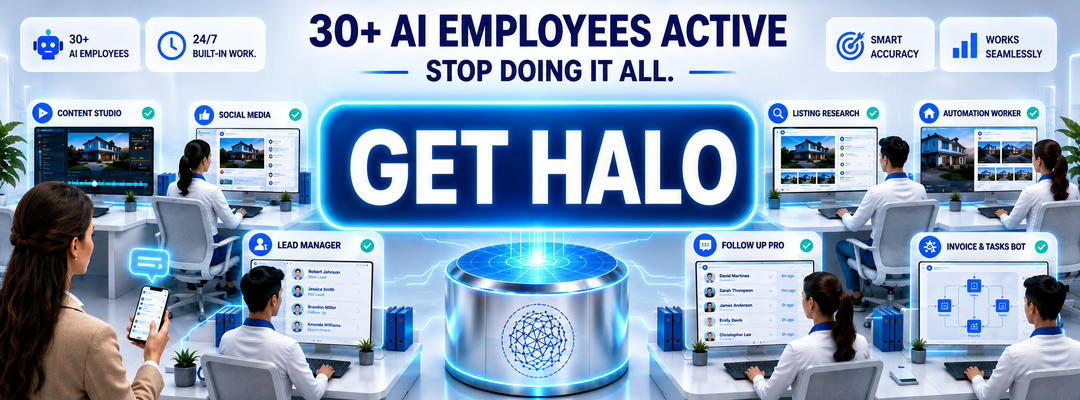
Halo uses more than 30 AI agents to support the work. These agents can help research the property, understand the neighborhood, create marketing copy, generate content, build website assets, and support lead capture.
For real estate agents, the challenge is usually not a lack of ideas. Most agents already know they should post more content, update their website, collect reviews, write about their market, and promote their listings. The hard part is doing all of it consistently while serving clients, negotiating deals, and running the business.
Halo is designed to remove much of that manual work, so agents can build a stronger online presence without managing every task themselves.
AI is powerful, but using it everywhere does not automatically create better marketing.
Forbes has pointed out that one of the biggest mistakes early AI adopters make in real estate is generic deployment. In other words, they insert AI wherever it is easy instead of using it where it creates the most business value.
That is an important distinction.
AI should not be used just to make more generic content. It should help agents solve real marketing problems, such as:
This is where Halo becomes useful. Instead of giving agents another random AI tool to manage, Halo is designed around the real marketing work agents already need to do. It connects the agent’s website, content, listings, reviews, local authority, and AI search strategy into one simpler workflow.
Halo is designed to work like an AI-powered Chief Marketing Officer for real estate agents.
Instead of logging into several platforms, managing dashboards, hiring different contractors, or trying to keep up with every new AI tool, the agent can send a text message. Halo then uses a team of AI agents to build, write, update, and manage the marketing assets behind the scenes.
Through the Krem Institute and Halo partnership, the offer includes:
With this system, an agent can create a website that is designed for human visitors and structured to be found and cited by AI.
The training showed a simple idea with major implications. If an agent wants a real estate website built around their niche, market, neighborhood, or lifestyle brand, they do not need to start with a complicated dashboard. They can start with a text.
One of the most practical parts of the demo was how easy the website can be updated.
For example, an agent can text Halo to:
Most agents do not need more tasks on their calendar. They need a faster way to execute the marketing tasks they already know are important.
A website that only gets updated once or twice a year will not build the same authority as a website that consistently publishes helpful, local, relevant content.
Halo is built around a simple idea. The agent should not need to become a developer, designer, SEO expert, or content manager. The agent only needs to know what they want, then send the instruction by text.
Reviews are one of the strongest trust signals in real estate.
However, many agents have reviews spread across different platforms. Some are on Zillow. Some are on Google. Some may be on Facebook, Realtor.com, or inside old messages and emails.
In the training, Eric explained that an agent could ask Halo to check for new reviews each week and update the website automatically. This allows the agent’s website to become a central place for social proof instead of leaving reviews scattered across the internet.
That helps in two ways.
First, human visitors can see proof from past clients. A buyer or seller wants to know that other people have trusted the agent and had a good experience.
Second, AI tools get clearer signals of authority. A website that includes helpful content, local expertise, and updated reviews gives search engines and AI platforms more context about why that agent is relevant in the market.
A generic real estate website is not enough anymore.
Every agent says they help buyers. Every agent says they help sellers. Every agent says they know the local market. The agents who stand out are the ones who build authority around a specific niche, community, lifestyle, or client type.
In the training, Eric gave examples of different website angles agents could use.
An agent could build a website around things to do in their city. Another could become the go-to resource for a specific neighborhood. Another could focus on a new subdivision, local lifestyle, restaurants, farmers markets, schools, parks, events, or relocation resources.
This is where AI-supported content becomes powerful.
Instead of publishing random blogs, the agent can build an intentional content strategy around the exact market they want to own.
For example, an agent could create content around:
This type of content helps the agent become more than another name in a search result. It helps them become a local authority.
Template websites can be helpful for getting online quickly, but they often do not build true authority.
The issue is not always how they look. Many template sites look polished. The issue is how they are structured, how specific the content is, how often they are updated, and whether they are designed for both search engines and AI tools.
A template website may fall short because it often:
A website built only around IDX search may help buyers browse homes, but it may not answer the questions buyers and sellers are asking before they are ready to search listings.
A website built only as a digital brochure may introduce the agent, but it may not build enough local content to support visibility.
A website built only for old SEO may still miss the structure needed for AEO and GEO.
That is why Nick and Eric positioned Halo differently. It is not just another website tool. It is designed to build and manage the agent’s digital authority across Google and AI search.
Real estate marketing should not take over an agent’s entire day.
With Halo, agents can create listing websites, property content, neighborhood pages, videos, review updates, and AI-search-friendly marketing assets with one simple text.
No complicated dashboard. No endless content planning. No starting from scratch every time.
Halo helps agents:
The goal is simple.
Halo helps agents spend less time stuck in marketing tasks and more time building relationships, serving clients, and winning listings.
Want to see how AI agents can help you build a smarter real estate business?
Join the Free Live AI Workshop, hosted by Nick Krem, CEO and co-founder of the Krem Institute of Artificial Intelligence every Thursday at 2 PM ET.
👉 Join the Free Live AI Workshop
Q: Can AI build a real estate website that ranks on Google and ChatGPT?
A: Yes. Halo is designed to build real estate websites with SEO as the foundation for Google visibility, while also using AEO and GEO structure to help the site become easier for AI tools like ChatGPT, Gemini, and Perplexity to understand and cite.
Q: How do I get my real estate website to show up in ChatGPT?
A: To show up in ChatGPT, your website needs clear, helpful, well-structured content that explains your market, niche, expertise, reviews, and local authority. Halo is built to create websites with this kind of structure so AI platforms can better understand the agent’s relevance.
Q: What is the difference between SEO, AEO, and GEO for real estate?
A: SEO helps your website rank on Google. AEO helps your content answer specific questions clearly. GEO helps generative AI tools like ChatGPT, Gemini, and Perplexity understand, cite, and source your content in AI-generated answers.
Q: Can I update my real estate website by text message?
A: Yes. With Halo, agents can text their AI CMO to update a headshot, add a blog post, write a market opinion piece, update site copy, or make changes to their website without logging into a dashboard.
Q: Can Halo sync Zillow and Google reviews?
A: In the training, Eric explained that agents can ask Halo to check for new reviews on platforms like Zillow and Google and update the website on a recurring basis. This helps keep social proof current and visible in one place.
Q: How much does an AI real estate website cost with Halo?
A: According to the Krem Institute and Halo offer page, the base subscription is listed at $99 per month, plus a $99 per listing fee. The offer includes an Authority Site, Community Site, Listing CMO support, and a 30-employee AI team.
.png)
.png)


.png)
.png)

.webp)