The agents who will survive the AI revolution will not be the ones who learn the most tools. They will be the ones who understand what makes them truly valuable.
Here’s the uncomfortable truth. Homebuyes and sellers using AI may take away more agent jobs than other agents using AI.
Not because agents are too slow to learn AI. But because consumers are learning it faster than most people expected, and they are starting to see how much of the job can now be done with ChatGPT, a simple prompt, and a few AI tools.
In 2024, a South Florida homeowner named Robert Lavine sold his home without using a single agent. He used ChatGPT for pricing, marketing, listing strategy, offer timing, and even contract creation. He got five offers within 72 hours and signed a contract within five days. He saved tens of thousands of dollars.
Was it luck? Maybe. But it was also a sign of what is coming. If you have been telling yourself that AI will never replace agents, you need a better way to look at it.
Because the real question is not whether AI will replace agents. The real question is which part of a real estate agent’s job is in danger, and which part is becoming even more valuable.
That difference is everything.
In this Live AI Workshop, Nick Krem, CEO and co-founder of the Krem Institute of Artificial Intelligence, breaks down why the AI-powered consumer is changing the market and how agents can stay valuable by focusing on the human side that AI cannot replace.
To understand where to put your energy, you need to travel back to 1943 and meet a statistician named Abraham Wald.
During World War II, the Allied forces were losing devastating numbers of bomber planes over Europe. Armoring the entire aircraft wasn't an option, they're too heavy to fly. So military leaders did what seemed perfectly logical: they collected data on every returning bomber, mapped where the bullet holes were concentrated, and prepared to armor those exact locations.
The data was clear. Returning planes were riddled with hits across the wings, fuselage, and tail sections. But the engines? Almost no damage at all.
So the obvious answer was to armor the wings and tail. That's where the planes are getting hit.
"Armor the areas where the returning aircraft were unscathed. Put the armor where there's no damage specifically the engines."
Wald saw something the military missed. The planes that came back weren't showing where planes were most vulnerable. They were showing where a plane could take a hit and still survive. The reason there were no bullet holes in the engines of returning planes wasn't because engines were safe. It was because any plane hit in the engine never made it back to be counted.
The most critical data was the data they couldn't see.
This is called survivorship bias. It's the mental trap of making decisions based only on what survived, while ignoring what didn't make it back to tell its story.
Now ask yourself, are you making the exact same mistake with your career?
.png)
Almost every piece of advice circulating in the real estate community right now sounds like this: learn AI tools.
Master prompt engineering, automate your follow-up, use AI for your listing descriptions, or your CMAs, or your social media.
And that advice is not wrong. It's just incomplete in a way that's going to cost a lot of people their careers.
Learning AI tools is the equivalent of armoring the bullet-riddled wings. It's what the surviving agents are visibly doing. It's necessary but it's not the thing that's going to save you long-term, because the moment AI makes a task easy enough that anyone can do it, agent or consumer, that task stops being a competitive advantage.
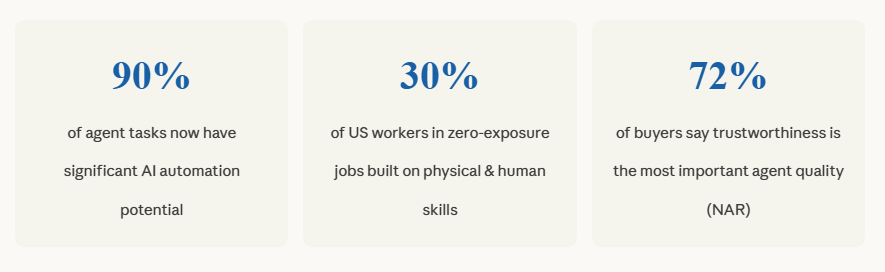
Research from Anthropic, one of the leading AI companies found that while many white-collar jobs have high theoretical exposure to AI automation, a full 30% of US workers are in what they classify as "zero exposure" jobs. These are roles built around things AI fundamentally cannot replicate like your physical presence, sensory judgment, and real-time human connection.
Your engine, which is the irreplaceable core of your value is built from exactly those things.
Let’s make this simple. AI can handle 90% of the routine work in real estate. The 10% remaining is your human edge, the part of the job that clients still need a real person for, and it is the part AI cannot truly replace. Here's what that means:
Notice what all of these have in common? They are hard, slow to develop, and deeply contextual. They require a body in the room, a history of lived experience, and the ability to read signals that don't exist in any dataset.
HAR.com also points out that although AI is reshaping real estate, it is unlikely to replace agents completely because so much of the job still depends on human connection, instinct, empathy, and experience. Those are exactly the kinds of strengths that make up the 10% AI cannot replace.
Let's zoom in on one of those skills, because it deserves its own conversation: emotional intelligence.
This isn't about being warm and friendly (though that helps).
Emotional intelligence in a real estate context means being able to sit across from a first-time buyer who is terrified of making the wrong decision and not just giving them data, but helping them trust themselves.
It means knowing when a seller needs to hear hard truth about their pricing, and how to deliver it in a way that doesn't blow up the relationship. It means sensing that a negotiation is about to go sideways before the other agent even knows it.
A Harvard Business Review analysis of high-performance sales professionals found that emotional intelligence was a stronger predictor of success than IQ or technical knowledge. In industries defined by high-stakes decisions and personal relationships, the ability to manage emotions, your own and others' is the ultimate differentiator.
ChatGPT can generate a beautiful CMA but it cannot sit in the living room of a grieving widow who just inherited a house she doesn't want, and make her feel genuinely understood.
Knowing the concept is one thing. Putting it into practice is another. Here's a simple, actionable framework for finding and protecting your irreplaceable engine.
1. Map the 90% and hand it off to AI
List every recurring task in your business. First draft listing descriptions, market reports, follow-up emails, social captions, MLS data entry, scheduling showings. These are the bullet-riddled wings. Let AI carry them. The goal isn't to do these tasks faster — it's to stop spending mental energy on them at all.
2. Identify and obsess over the 10%
Ask yourself, what is it that I do in a transaction that no app, no algorithm, and no out-of-town agent could replicate? That moment when a deal is about to fall apart and your calm presence holds it together, that's your engine. Name it specifically, write it down and build it deliberately.
3. Shift your identity from facilitator to consultant
Transaction facilitators are being replaced by AI tools, by discount brokers, by empowered consumers. Trusted consultants are not. Your positioning, your messaging, and your client experience should all reflect a single idea:
"I am not here to process your paperwork. I am here to guide you through one of the most complex decisions of your financial life."
Robert Lavine, the South Florida homeowner, wasn't a tech entrepreneur.
He was a dad who decided to challenge himself. He used free tools that anyone with an internet connection can access. And he pulled off a successful FSBO with five offers in 72 hours.
He did hire a lawyer to review the contract. But other than that? The AI handled it.
This is not a story about how everyone will sell their own homes. It's a story about a shift in consumer confidence. As AI tools get better, more consumers will feel equipped to handle the parts of the transaction they used to need an agent for.
Which means the agents who survive won't be the ones who automate the fastest. They'll be the ones who offer something the AI-powered consumer still can't get on their own like a real human judgment, local relationships, and the ability to navigate chaos when things go wrong.
That's your engine. That's the armor that belongs there.
Looking for another practical way to use AI in your business? Read our previous blog, Turn Real Estate Photos Into Cinematic Videos Using AI for Free, to learn how agents can create eye-catching video content without extra cost.
AI is not replacing real estate agents. But it is replacing the parts of the job that were never your true advantage.
The agents who win in this next chapter will not be the ones who learn the most tools. They will be the ones who understand what makes them irreplaceable and double down on it.
So the real question is, are you ready for the AI-powered real estate market or are you still focused on the part of the job that is disappearing?
Ready to build your 10% and let AI handle the rest?
Join the Free Live AI Workshop every Thursday at 2 PM Eastern. Hosted by Nick Krem, CEO and co-founder of the Krem Institute of Artificial Intelligence, learn how to use AI in your business without losing the human edge that sets you apart.
👉 Join the Free Live AI Workshop
Q: Will AI replace real estate agents completely?
A: AI is not likely to fully replace real estate agents. However, it will replace agents who do not adapt. The routine parts of the job, like admin work and basic tasks, can be automated. But the human side, like building trust, guiding clients emotionally, negotiating, and understanding the local market, cannot be replaced. Agents who focus on these skills will become even more valuable.
Q: What skills make a real estate agent AI-proof?
A: The most important skills are emotional intelligence, strong local market knowledge, negotiation, problem-solving, and the ability to build real trust with clients. These skills come from real experience and human interaction, which AI cannot fully copy.
Q: Should real estate agents learn AI tools?
A: Yes, but with the right approach. Agents should use AI to handle the routine 90% of their work, like writing, planning, and admin tasks. This allows them to spend more time on the 10% that matters most, which is building relationships and making important decisions with clients.
Q: What is survivorship bias and why does it matter?
A: Survivorship bias is when you only look at what is working and ignore what is not. In real estate, this happens when agents focus only on learning AI tools because that is what they see others doing. But the real advantage comes from strengthening the human skills that keep your business strong long term.
Q: Can people really sell homes without an agent using AI?
A: Some people already are. AI tools have made it easier for sellers to handle parts of the process on their own. But real estate can still be complex. Negotiations, unexpected problems, and difficult situations often need a skilled agent. The bigger shift is not that everyone will go FSBO, but that buyers and sellers feel more confident, which means agents need to offer more value than before.
.png)

.png)
.png)

.webp)