Case Study
How to Get ChatGPT to Recommend You: Sharon Glatz Scott’s Downsizing Case Study
See how a Mercer Island agent got a condo listing from an 80-year-old seller who found her on ChatGPT, and how to copy her niche homepage and FAQs.
 Presented byNick Krem
The win in numbers
- 80year-old seller
- 1condo listing
- 26FAQ questions
- 98A.I. score, up from 69
 Watch the videoDo This So ChatGPT Sends You Clients (Real Agent Case Study)
In this video: 12 chapters
- 0:00An 80-year-old seller found her on ChatGPT
- 0:46The question ChatGPT answered
- 1:10A homepage that says who it serves
- 1:50Why readers should listen to her
- 2:35Downsizing on every page
- 3:24A bio page anyone can check
- 4:00Why FAQs matter for A.I. search
- 5:40Her blog posts and FAQ page
- 7:07Dating every answer
- 7:28How Halo’s research agent works
- 9:23From a 69 to a 98
- 9:42The three locks
Key Takeaways
- ChatGPT named Sharon Glatz Scott when someone asked who could help them downsize on Mercer Island.
- That answer turned into a condominium listing with an 80-year-old seller.
- Her homepage says who she serves first, then why you should trust her.
- The word downsizing runs through her homepage, guides, FAQs and blog posts.
- Her FAQ page answers 26 real questions, and her Halo site scores 98 out of 100, up from about 69 on her brokerage site.
In This Case Study
- How ChatGPT Sent Sharon a Downsizing Listing
- A Homepage That Names Her Ideal Client
- The Line That Earns a Reader's Trust
- Downsizing on Every Page of Her Site
- A Bio Page Anyone Can Check
- 26 Questions, Each With a Real Answer
- How Halo Builds Pages Like Hers
- From a 69 to a 98
- The Three Locks A.I. Has to Open
- Final Thoughts
- FAQs
Some agents worry that A.I. search is only for younger clients. Then an 80-year-old seller hands you a listing, and when you ask how they found you, the answer is ChatGPT.
That's what happened to Sharon Glatz Scott, a real estate agent who helps people downsize on Mercer Island, in Bellevue and across the Greater Eastside of Washington. Let's walk through her website piece by piece, because every part of it is something you can copy on your own site.
How ChatGPT Sent Sharon a Downsizing Listing
Sharon knows exactly who she wants to work with: people who are downsizing on her side of the market. Her website says so, again and again.
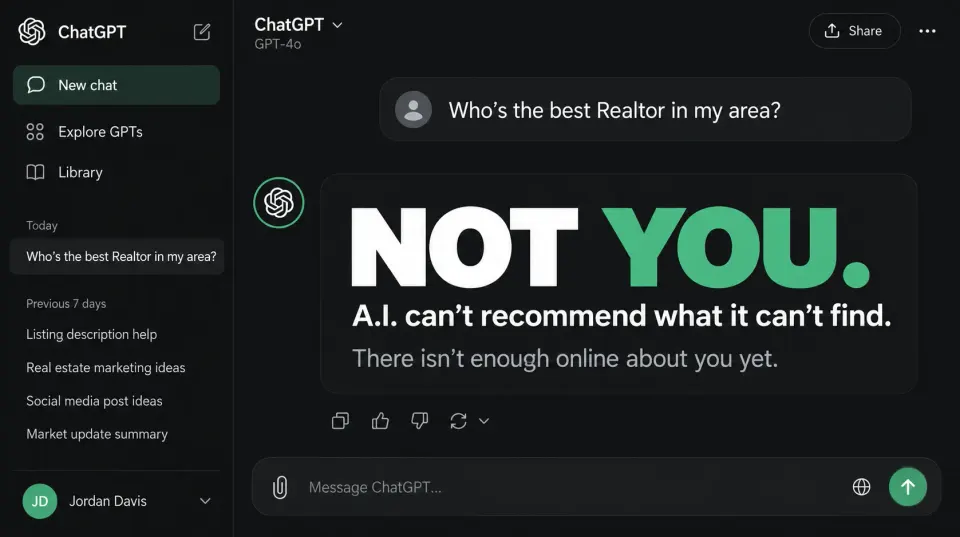
Then someone asked ChatGPT who could help them downsize on Mercer Island. ChatGPT came back with one name, and it was Sharon's.
The seller was 80 years old, and Sharon walked out of that appointment with a condominium listing. As she wrapped up, she asked how they had found her.
Notice what was asked. Nobody typed "best Realtor." They described their situation, so the agent who describes that same situation on her site has the best shot at being named.
 The success story
Sharon Glatz Scott's Client Found Her on ChatGPT
An 80-year-old client, right in Sharon Glatz Scott's niche, found her through ChatGPT.
Read the story
In short: Describe your clients' situation on your site, because that's how they describe it to ChatGPT.
A Homepage That Names Her Ideal Client
Open Sharon's site, and the first thing you read is a short promise: "Less House. More Life."
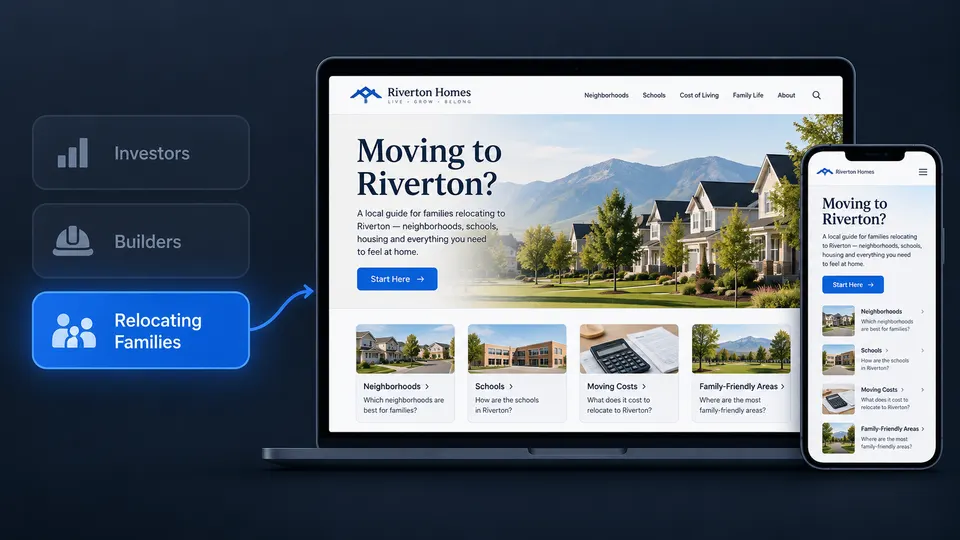
Right under it, she spells out the service and the place: downsizing real estate help on Mercer Island, Bellevue and the Greater Eastside. Within a few seconds, a reader knows whether this site is for them, and so does an A.I. tool reading the page.
It's one of the oldest rules in marketing, and it matters even more in A.I. search. If you try to speak to everybody, you end up speaking to nobody, because there's no clear answer for A.I. to repeat.
In short: Say who you help and where, in the first line people read.
The Line That Earns a Reader's Trust
Once Sharon says who she serves, she goes straight to why you should listen to her. That authority piece sits near the top of the page, so nobody has to dig for it.
Put the two together and the formula is simple: say exactly who you work with, then say why they should trust you.
- Mercer Island resident since 1977
- 14 years licensed
- 120+ homes sold
- SRES and AI Certified
Here’s a pro tip
If your site doesn't open this way, fix it with one text to Halo: "Add the authority part of my bio to the top of my website." Halo adds it for you.
In short: Who you serve first, why to trust you right after.
Downsizing on Every Page of Her Site
As you move through Sharon's site, one word keeps coming back: downsizing. It's in her overview, her guide, her FAQs and her blog posts.
Her homepage even has a section on how she helps clients through life transitions, which is exactly where many downsizers find themselves. Because every page points to the same specialty, A.I. tools get one clear picture of what she does and where she does it.
She also uses her own photos throughout, including in her blog posts and area spotlights. With Halo, that takes one step: text the picture and say where you want it.
In short: One specialty, repeated on every page, gives A.I. one clear answer about you.
Text Halo. It gets done.
Your Market. One Text Away.
FAQ Pages. One Text Away.
Blog Posts. One Text Away.
A.I. Search. One Text Away.
Text Halo what you need, and it makes it while you get on with your day.
See how it worksA Bio Page Anyone Can Check
Sharon's About page makes her easy to verify. It lists her brokerage, where she's located and how long she's been in the area, and it links out to the other places she can be found.
That lines up with Google's guidance on creating helpful, reliable, people-first content, which asks whether readers can easily see who created a page and what experience stands behind it.
So when A.I. tools look for proof that she is who she says she is, the facts line up. Clear credentials make a recommendation feel safe, both for the tool making it and for the person reading it.
In short: List your brokerage, your area and your years there, so anyone can check them.
26 Questions, Each With a Real Answer
FAQs might be the most important part of Sharon's site. That's because of answer engine optimization (AEO) and generative engine optimization (GEO), which are about giving A.I. tools clear answers they can pass along.
More and more, people get their answer right on the search page or inside a chat, without clicking through to a website. So instead of fighting that, Sharon gives A.I. the questions people ask, with real answers.
Each question is written the way people ask it, like "Should I stay in my home or downsize?", "What condo costs should I plan for?" and "How long does downsizing take?", and the answers include real numbers.
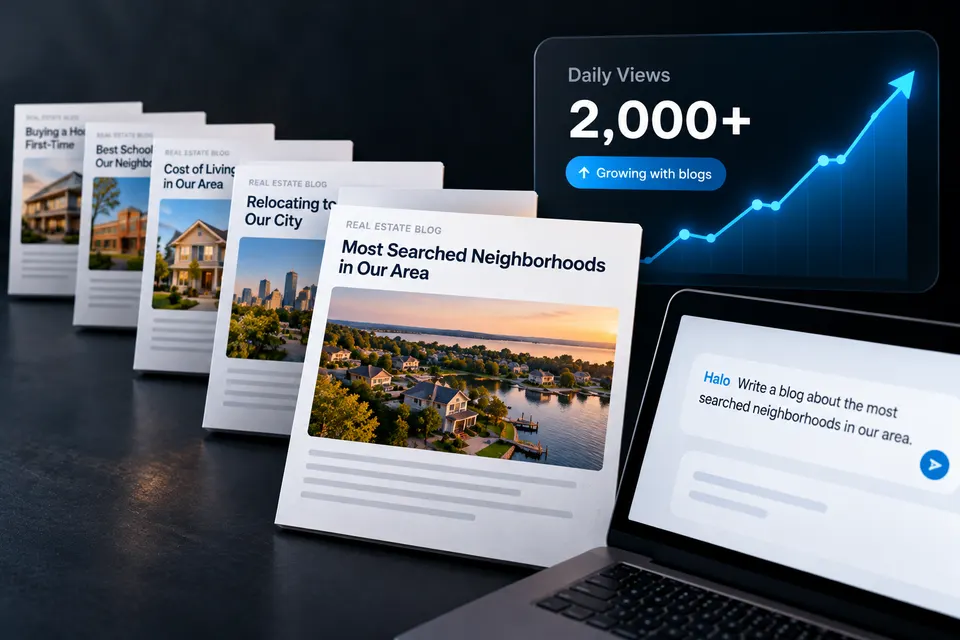
Her blog goes deep too, including an article with estimated seller net figures for different areas. Halo researched that topic, found the keywords and wrote the post for her.
On top of that, every answer is dated. A date shows readers and A.I. tools when the answer was written, which makes the page easier to trust when someone wants up-to-date information.
Here’s a pro tip
Want FAQs like Sharon's? Text Halo, "What are the most frequently asked questions from people looking to downsize in [your area]?" Halo researches the questions, puts each exact question in its title and writes the answer.
In short: Real questions, real answers and a date on each one.
How Halo Builds Pages Like Hers
Halo works like a marketing agency you can text, with a team of 30+ A.I. employees inside it. That includes a web developer, an SEO, AEO and GEO specialist and a research agent. When you ask for content, they hand the work down the line:
- Research agentFinds the questions your ideal clients ask most
- CopywriterWrites a post that answers one of them
- Keyword specialistMakes sure it uses the right keywords
- Web developerAdds the schema and code, then publishes it
- Live on your siteReady for people and A.I. to read
You never have to touch the schema or the code. You can even ask Halo to blog for you three times a week, and the whole chain runs each time.
In short: One text, and Halo's team researches, writes, optimizes and publishes.
From a 69 to a 98
Many brokerage sites aren't built for AEO or A.I. search, and Sharon's was no exception. Her brokerage site scored about 69. Her Halo site scores 98 out of 100, and that gap is a big part of why ChatGPT picked her.
A recommendation like the one Sharon got doesn't happen by accident. It comes down to the work behind the site.
In short: A site built for A.I. search gives ChatGPT more reasons to name you.
The Three Locks A.I. Has to Open
Think of your website as a door with three locks. Before A.I. recommends you, each one has to open:
The first lock is whether A.I. can read your site at all. Google spells this out in its page on A.I. features and your website: a page has to be indexed and eligible to show in Google Search before it can appear as a supporting link in those A.I. answers. The second is whether it knows your story and why someone should work with you. The third is whether it can find answers to the questions your clients ask. Sharon's site opens all three, and that's why her name came up.
In short: Readable, known and full of answers: open all three locks.
Your first week
Win the Day, Five Days in a Row
- Day1Write one sentence: who you help, and where.
- Day2Put it at the top of your homepage, with why to trust you right under it.
- Day3Check your bio page: brokerage, location and years in the area.
- Day4Text Halo for the questions people in your niche and area ask most.
- Day5Ask every new client how they found you, and write the answer down.
Final Thoughts
Sharon's win came from a site that says who she serves, why she can be trusted and what her clients want to know, on every page.
So pick your specialty and your area, put them at the top of your homepage and fill your site with real answers to real questions. No Halo site yet? Free Guide 1 shows how to get your free Smart Site by text. When the next person asks ChatGPT for help with exactly what you do, you want your name to be the one it gives.
Your move
Sharon named her client first. Name yours.
 Halo Live / Case Study
See how real estate agents turn A.I. visibility into real business.
Every Tuesday, Nick Krem walks through one real estate agent's success and the Halo site behind it.
- Real results
- Live walkthrough
- Practical takeaways
Next live session
Every Tuesday
12 PM ET · Live on Zoom
Hosted by Nick KremA new agent's playbook every weekAdmit oneFree
Reserve Your Free SeatWhat you'll walk away with
- The WinWho found them, how they found them, and what it turned into.
- The PlaybookA live walkthrough of their Halo site and what made it work.
- Your TurnTake the playbook and apply it in your own market.
FAQs
How do you get ChatGPT to recommend you as a real estate agent?
Make your website clear about who you serve, where you work and why people should trust you, then answer the questions your clients ask. A Halo site built this way helped ChatGPT recommend Sharon Glatz Scott, a downsizing agent on Mercer Island, Washington.
What should a real estate agent put at the top of their homepage?
State exactly who you work with and where, then explain why readers should listen to you. A line like "Downsizing Real Estate Help on Mercer Island, Bellevue and the Greater Eastside" tells both people and A.I. tools who the site is for.
Why do FAQs help real estate agents show up in A.I. search?
A.I. tools look for clear answers to the questions people ask. An FAQ page that uses each real question as a title and gives a real answer, with numbers where they help, gives those tools something they can pass along.
Should the answers on a real estate FAQ page be dated?
Yes. A date shows readers and A.I. tools when each answer was written, which makes the page easier to trust when someone is looking for up-to-date information.
How does Halo write blog posts and FAQs for real estate agents?
Halo's research agent asks ChatGPT, Claude, Perplexity and Gemini what your ideal clients want to know. Then a copywriter writes the post, a keyword specialist checks the keywords and a web developer adds the schema and publishes it on your site.
What are the three things A.I. needs from a real estate website?
A.I. needs to be able to read your website, know who you are and why people should work with you, and find answers to the questions your clients ask.
Presented by Nick Krem. Written and researched by the AI team of the Krem Institute of Artificial Intelligence.